
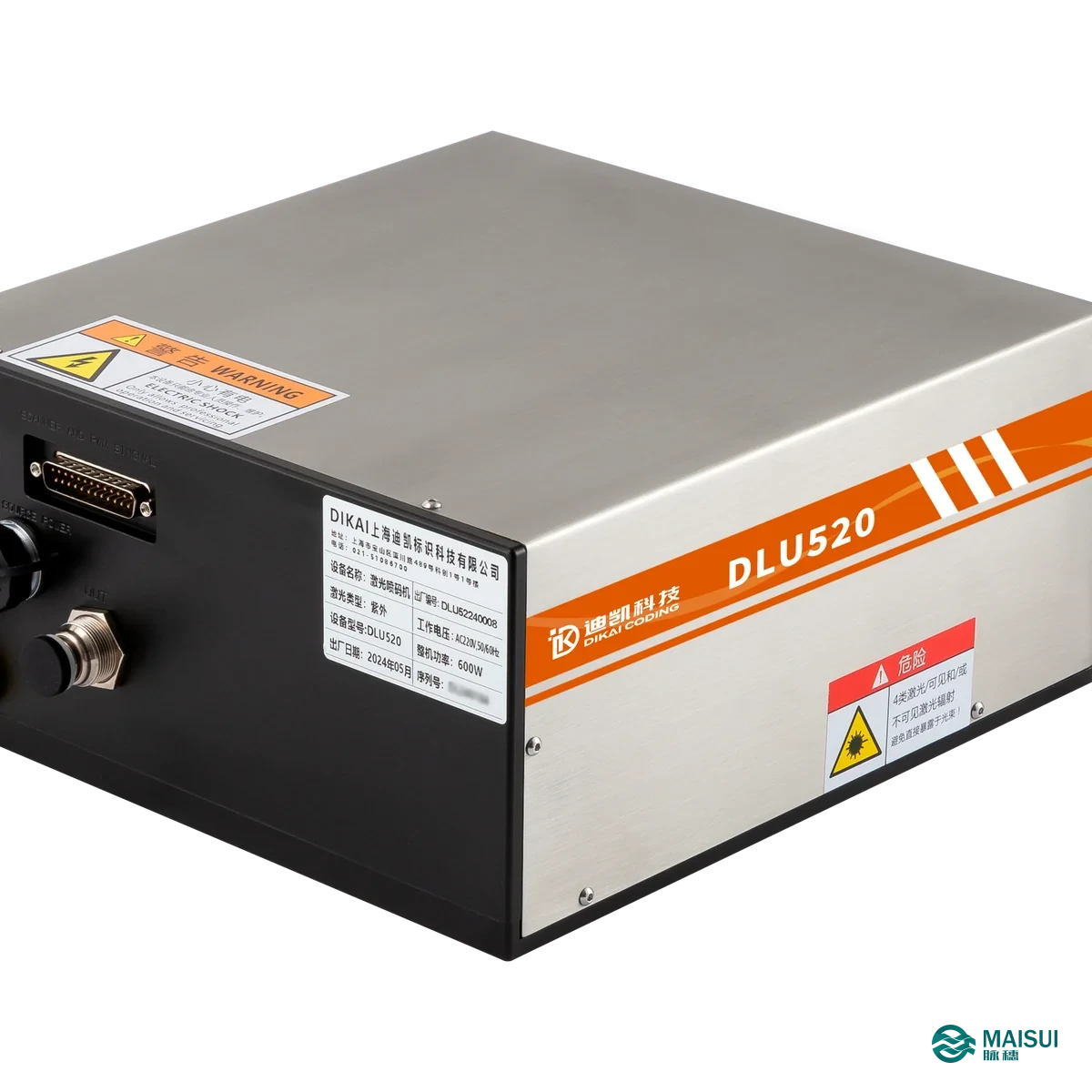
The Dikai DLU520 is a small UV laser printer – the laser body measures only 274 x 258 x 125 mm – intended to replace a thermal transfer overprinter at the same position on a packaging line. It marks flexible film, HDPE, LDPE, PP and metal at 355 nm with a 5 W source and no consumable, and the mark is permanent and cannot be erased.
Key facts at a glance
- Category
- UV laser printer (coding and marking)
- Brand / model
- Dikai DLU520
- Laser source
- UV laser, 355 nm, 5 W
- Marking fields
- 70 x 70 mm and 110 x 110 mm
- Scan speed
- Up to 8,000 mm/s
- Body size
- 274 x 258 x 125 mm
- Cooling
- Water cooling
- Protection
- IP54
What it is
A UV laser printer writes a permanent code onto the packaging surface with a 355 nm cold beam instead of a ribbon and printhead. The DLU520 was designed around the physical envelope of a TTO unit, so it can take the same mounting position on a pouch or flow-wrap machine while removing the consumable, the printhead wear and the ribbon change.
How it works
- Mount the laser body at the working distance for the 70 mm or 110 mm field, in any orientation.
- Connect the touch panel and set the message, date rules and code content.
- Trigger one mark per product from the machine; 2 inputs and 3 outputs are available.
- Check first packs for contrast and grade.
- Run continuously – there is no ribbon to change and no printhead to clean between shifts.
Key capabilities
- Small body. 274 x 258 x 125 mm, close to the footprint of the TTO it replaces.
- TTO replacement. Fits the coding position on a packaging machine without a ribbon path, so the line layout does not have to change.
- Permanent mark on film. Marks HDPE, LDPE, PP and mono film without burn-through, and the mark cannot be erased.
- No consumable or pollution. No ink, ribbon or solvent; the process does not produce the solvent emissions of an ink-based coder.
- Non-contact. Nothing touches the pack, so the mark does not depend on contact pressure or print gap.
- Blue light guiding. A visible guide light makes it easier to align the mark position during setup.
- Rich content. JSF, TrueType and DMF fonts, barcodes, 2D codes and DXF/PLT vector images.
- IP54 and water cooled. Protected for the production hall, with a separate chiller.
Where it fits
It is the model to consider where a TTO has become the maintenance bottleneck: ribbon changes, printhead wear and print-gap adjustment all disappear, and the mark on the film is permanent. The two smaller fields suit date and batch codes on pouches and flow-wrap packs rather than large logos.
Technical specifications
| Applications | Soft packaging film, HDPE, LDPE, PP, metal and similar |
|---|---|
| Marking method | X and Y axis simultaneous scanning |
| Marking mode | Flying mark 150 m/min; static mark, multiple products at the same time |
| Laser type | UV laser |
| Wavelength | 355 nm |
| Output power | 5 W |
| Guiding laser | Blue light guiding |
| Marking area / distance | 70 x 70 / 135 mm, 110 x 110 / 218 mm |
| Scanning speed | Up to 8,000 mm/s |
| Fonts | JSF, TrueType, DMF |
| Barcodes | Code 39, Code 25, EAN-13, Code 128 and others |
| 2D codes | PDF417, QR code, DataMatrix |
| Images | DXF / PLT vector diagrams |
| Inputs / outputs | 2-way input / 3-way output, customisable |
| Interface | SD card, USB 2.0 and communication interface |
| Installation direction | Any direction |
| Cooling | Water cooling |
| Power supply | 100-240 V, 10 A, 47/63 Hz |
| Power consumption | 600 W |
| Working temperature | 5 to 45 degrees C |
| Working humidity | 10 to 90 percent, no condensation |
| IP rating | IP54 |
| Dimensions | Laser 274 x 258 x 125 mm; touch screen 305 x 207 x 56 mm; chiller 345 x 249 x 560 mm |
Selection checklist
- What code size is needed – does it fit the 70 mm or 110 mm field?
- What line speed, and does the 150 m/min flying mode cover it?
- Is the current TTO position free for a non-contact head?
- Where will the chiller and touch screen be mounted?
- Which trigger signal does the packaging machine provide?
- Does the code need GS1 or retailer-specific content?
- Is the film HDPE, LDPE, PP or a laminate? A sample test confirms contrast.
- Who will service the cooling loop and lens?
Maintenance and service
The DLU520 removes the TTO maintenance routine – no ribbon, no printhead, no print gap – and replaces it with cooling loop and lens care. That is usually the point of the upgrade: fewer stops per shift and no consumable to store. MAISUI supplies, installs and services the unit, and can quote it as a direct replacement for an existing TTO position.
Frequently asked questions
Can the DLU520 replace our TTO printer directly?
It was designed for that. The laser body is 274 x 258 x 125 mm, close to the space a TTO occupies, and it needs no ribbon path. The mounting and trigger signal are the main things to check.
Does it work on PE film?
Yes – HDPE, LDPE, PP and mono film are the listed applications. Mark contrast varies with the pigment and additives, so a sample test on your actual film is the reliable check.
Is there any consumable?
No ink, ribbon or solvent. Operating cost is electricity plus cooling loop and lens maintenance.
What marking fields are available?
70 x 70 mm at 135 mm and 110 x 110 mm at 218 mm – sized for date, batch and 2D codes rather than large logos.
How fast is flying marking?
150 m/min in flying mode, with a scan speed up to 8,000 mm/s.
Does it need a chiller?
Yes, it is water cooled; the chiller measures 345 x 249 x 560 mm and needs its own space and power point.
What can it print?
JSF, TrueType and DMF fonts, Code 39/25/128 and EAN-13 barcodes, PDF417/QR/DataMatrix and DXF/PLT vector graphics.
Is the mark really permanent?
It is a laser mark in the material surface, not an ink or ribbon transfer, so it does not rub off or wash away.