
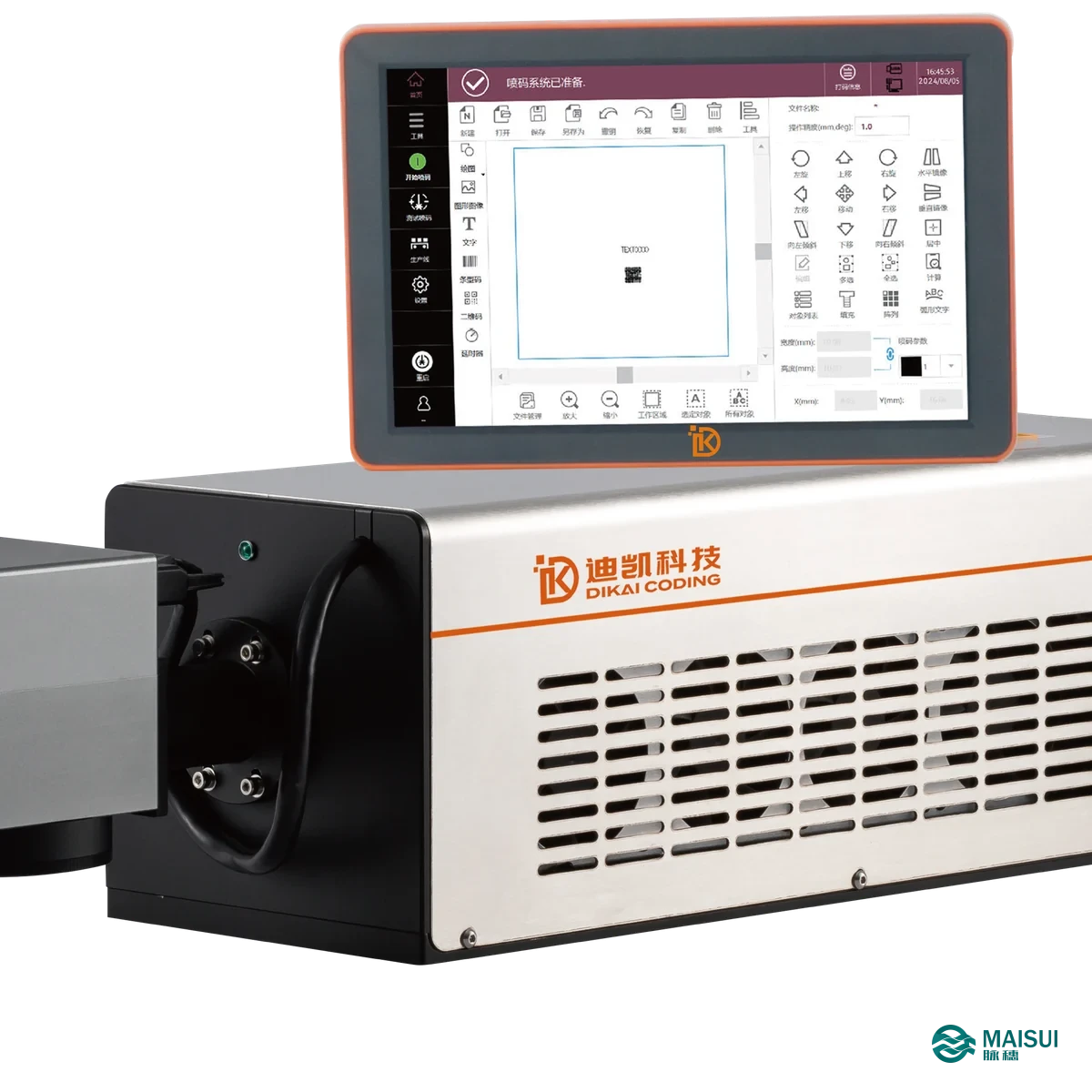
The Dikai DLC300 and DLC600 are CO2 laser printers with 30 W and 60 W sources, a 10.6 um wavelength and air cooling. They mark paper boxes, flexible packaging film, plastic bottles and glass bottles with permanent text, barcodes and 2D codes, controlled from a 10-inch Linux touch screen and running at up to 8,000 mm/s (12,000 mm/s optional).
Key facts at a glance
- Category
- CO2 laser printer (coding and marking)
- Brand / model
- Dikai DLC300 / DLC600
- Wavelength
- 10.6 um default; 9.3 um and 10.2 um optional
- Output power
- DLC300: 30 W / DLC600: 60 W
- Marking speed
- 8,000 mm/s, 12,000 mm/s optional
- Marking area
- 70 x 70 mm to 175 x 175 mm, four focal options
- Controller
- Linux system, 10-inch touch screen
- Cooling
- Air cooling
DLC300 and DLC600 at a glance
| Item | DLC300 | DLC600 |
|---|---|---|
| Output power | 30 W | 60 W |
| Power consumption | 500 W | 600 W |
| Laser body dimensions | 708 x 172 x 167 mm | 868 x 172 x 167 mm |
| Wavelength | 10.6 um default; 9.3 um and 10.2 um optional | |
| Cooling | Air cooling | |
What it is
A CO2 laser printer puts a permanent mark on the pack by removing or carbonising a thin surface layer. There is no ink, ribbon or label, so the mark cannot be rubbed off or washed away, and the only operating input is electricity. CO2 is the right family for paper, cardboard, coated board, many plastics and glass; it is the wrong family for thin mono film where the mark would burn through.
How it works
- Mount the laser body on the line, at the focal distance for the chosen marking area.
- Connect the touch screen controller and set the message, code content and date rules.
- Configure flying mode for a moving line or static mode for a fixed position.
- Trigger the mark from the machine signal; status outputs report running, ready and fault.
- Check the first production packs for contrast and code grade, then run continuously.
Key capabilities
- 30 W and 60 W sources. The 30 W model covers standard carton and film coding; the 60 W model is chosen for higher line speed, deeper marking or a wider mark.
- Flying and static marking. Flying mode marks while the product moves, up to 150 m/min as standard (200 or 300 m/min optional). Static mode can mark several products at one position.
- Four focal lengths. 70 x 70 mm at 100 mm, 110 x 110 mm at 150 mm, 140 x 140 mm at 200 mm and 175 x 175 mm at 250 mm.
- Linux touch controller. A 10-inch screen with 26 built-in fonts and user-defined fonts, so the line operator does not need a PC.
- Wide material range. Paper boxes, flexible packaging film, plastic bottles and glass bottles – the common packaging surfaces in food, beverage and consumer goods.
- Air cooled. No chiller and no coolant loop; the unit needs only the specified air clearance around the intake.
- IP54 build, IP65 optional. Dust and splash protection for the production hall, with a higher option for washdown areas.
- Standard interfaces. USB, Ethernet and RS232, with 2-way input and 3-way output for line integration.
Where it fits
The usual positions are cartoners, case packers, labelling lines and bottle lines where a permanent date, lot or 2D code has to be applied without a consumable. Where the packaging is a thin mono film, a UV laser is normally the better choice than a CO2 unit.
Technical specifications
| Applicable materials | Paper boxes, flexible packaging films, plastic bottles, glass bottles |
|---|---|
| Scanning method | X and Y axis simultaneous scanning |
| Marking mode | Flying mode 0-150 m/min (0-200 and 0-300 m/min optional); static mode, multiple products at the same time |
| Laser type | CO2 laser generator |
| Wavelength | 10.6 um default, 9.3 um and 10.2 um optional |
| Output power | DLC300: 30 W; DLC600: 60 W |
| Guide light | Red guide light |
| Marking area / focal distance | 70 x 70 / 100 mm, 110 x 110 / 150 mm, 140 x 140 / 200 mm, 175 x 175 / 250 mm |
| Marking speed | 8,000 mm/s, 12,000 mm/s optional |
| Controller | Linux system, 10-inch touch screen |
| Fonts | 26 built-in fonts, user-defined fonts supported |
| Barcodes | Code 39, Code 25, EAN-13, Code 128 and others |
| 2D codes | PDF417, QR code, DataMatrix |
| Graphics | BMP, DXF, PLT, HPGL, JPEG |
| Variable data | Serial number, text, date, time, counter, shift code |
| Inputs / outputs | 2-way input / 3-way output, customisable |
| Interface | USB, Ethernet, RS232 |
| Laser installation | Arbitrary direction |
| Cooling | Air cooling, at least 10 cm clearance at the air inlet |
| Power supply | AC 100-240 V, 50/60 Hz |
| Power consumption | DLC300: 500 W; DLC600: 600 W |
| Operating temperature | 5 to 40 degrees C |
| Operating humidity | 10 to 90 percent, non-condensing |
| IP rating | IP54, IP65 optional |
| Dimensions | Laser body 708 x 172 x 167 mm (DLC300) or 868 x 172 x 167 mm (DLC600); touch screen 252 x 168 x 36 mm |
Selection checklist
- Is the packaging paper, board, plastic or glass? CO2 suits these; thin mono film usually needs UV.
- What mark size is needed, and therefore which focal length?
- What is the line speed in metres per minute, and does flying mode cover it?
- Is 30 W enough, or does the line need the 60 W source?
- Is the area washdown? Then specify the IP65 option.
- Which signal does the machine provide to trigger the mark?
- Does the code content need GS1 or retailer-specific structure?
- Is there clear space at the air inlet for cooling?
Maintenance and service
Air-cooled CO2 units need intake clearance kept clear, a clean lens window and periodic checks of the marking quality. There is no ribbon, ink or chiller coolant to manage, which keeps the operating routine short. Where dust is heavy, schedule lens cleaning more often than the generic interval.
MAISUI supplies the unit with line installation, operator training and spare parts, and can quote a replacement where an existing CO2 coder has reached the end of its service life.
Frequently asked questions
What is the difference between DLC300 and DLC600?
Output power: 30 W for the DLC300, 60 W for the DLC600. The higher power is used for faster lines, deeper marks or wider marks; the laser body is also longer on the DLC600.
Can it mark film?
It can mark many flexible packaging films, but thin mono film is usually better served by a UV laser to avoid burn-through. Send the film structure and we will advise which family fits.
How fast can it mark a moving product?
Flying mode is 0-150 m/min as standard, with 0-200 and 0-300 m/min as options. The achievable speed depends on the mark content and the material.
Does it need a chiller?
No. The DLC series is air cooled and only needs at least 10 cm clearance at the air inlet.
Is the IP rating enough for a wet area?
IP54 is the standard rating, suitable for dust and splashes. IP65 is available as an option for washdown or wet environments.
What can the controller print?
Text, dates, serial numbers, counters, shift codes, Code 39/25/128 and EAN-13 barcodes, PDF417, QR and DataMatrix codes, and BMP/DXF/PLT/HPGL/JPEG graphics.
Can it replace an inkjet coder?
Often yes – CO2 needs no ink or solvent and leaves a permanent mark on paper, board, plastics and glass. Where colour or an ink-based mark is required, a continuous inkjet is still the better fit.
What are the power requirements?
AC 100-240 V, 50/60 Hz, drawing 500 W (DLC300) or 600 W (DLC600).