
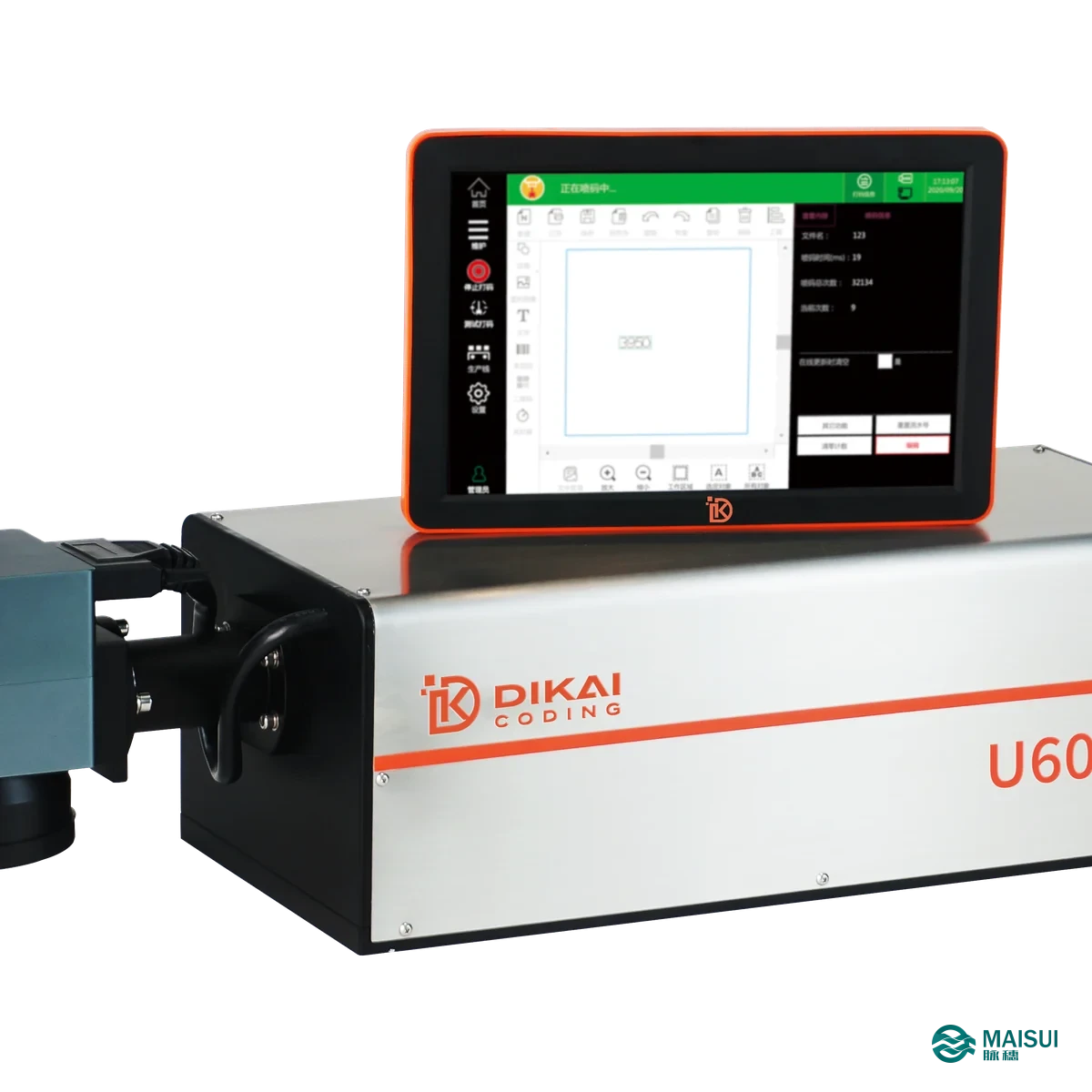
The Dikai U6010 and U6005 are UV laser printers that mark flexible film, labels and cartons with a 355 nm cold laser source, so the code changes the surface without burning through it. The U6010 uses a 10 W source at up to 12,000 mm/s, the U6005 a 5 W source at up to 8,000 mm/s; both have IP65-rated laser sources and a separate water chiller.
Key facts at a glance
- Category
- UV laser printer (coding and marking)
- Brand / model
- Dikai U6010 / U6005
- Laser source
- UV (Nd:YVO4), 355 nm
- Output power
- U6010: 10 W / U6005: 5 W
- Scan speed
- U6010: 12,000 mm/s / U6005: 8,000 mm/s
- Marking range
- 110 x 110 mm to 400 x 400 mm, four lens options
- Interface
- USB 2.0, Ethernet
- Cooling
- Split water chiller
U6010 and U6005 at a glance
| Item | U6005 | U6010 |
|---|---|---|
| Laser power | 5 W | 10 W |
| Scan speed | 8,000 mm/s | 12,000 mm/s |
| Marking range and working distance | 110 x 110 mm (WD 213 mm), 175 x 175 mm (WD 300 mm), 250 x 250 mm (WD 430 mm), 400 x 400 mm (WD 580 mm) | |
| Laser source protection | IP65 rated | |
| Cooling | Water chiller | |
What it is
A UV laser printer writes permanent codes onto the packaging itself rather than onto a label or a ribbon. The 355 nm wavelength is absorbed in a thin surface layer, which produces a high-contrast mark on materials that a CO2 or fibre laser would burn, distort or puncture – mono film, HDPE, LDPE, labels and cartons. Because there is no ink, ribbon or solvent, the cost per code is essentially the electricity, and there is nothing to run out of mid-shift.
How it works
- The print unit is mounted on the packaging machine or conveyor, with the lens at the working distance for the chosen marking range.
- The water chiller circulates coolant to the laser source; it is a separate unit and needs its own floor or frame space.
- The 10-inch touch panel loads the message: date rules, batch, serial, text, logos, barcodes and 2D codes.
- A trigger signal from the machine fires the mark; a single input can fire one mark per product, and outputs report marking status.
- The operator checks the first packs for contrast and code grade, then the line runs without consumable changes.
Key capabilities
- Cold marking on film. The 355 nm source marks HDPE, LDPE and mono film without pin-holing or thermal damage, which is the usual failure mode when a CO2 laser is applied to thin film.
- High-contrast permanent codes. Text, logos and 2D codes (DataMatrix, QR) stay legible through the pack’s life without ink to fade or ribbon to smudge.
- IP65 laser source. The source is sealed against dust and water jets, so it can sit in a washdown area or a dusty filling hall.
- Two power classes. The 5 W U6005 covers standard line speeds; the 10 W U6010 allows either faster marking or a larger mark in the same cycle time.
- Four marking ranges. 110, 175, 250 and 400 mm square fields, each with its own working distance, so the same controller covers a small sachet and a large carton.
- No consumables. No ink, ribbon or solvent to buy, store or dispose of.
- Standard data interfaces. USB 2.0 and Ethernet, with 2 inputs and 3 outputs for line signalling.
- Integrated controller. The touch panel is the operator interface; no separate PC is needed at the line.
Where it fits
Typical positions are vertical form-fill-seal machines, pouch lines and cartoners where the code has to be permanent and the packaging is too thin or too sensitive for a hot-stamp or CO2 marker. The 5 W model suits normal packaging speeds; the 10 W model is chosen where the line runs fast or the mark is dense.
Technical specifications
| Applicable material | Rigid plastic material, mono film, labels and cartons |
|---|---|
| Laser type | UV laser (Nd:YVO4) |
| Wavelength | 355 nm |
| Output power | U6005: 5 W; U6010: 10 W |
| Laser source IP rating | IP65 |
| Marking range (working distance) | 110 x 110 mm (WD 213 mm), 175 x 175 mm (WD 300 mm), 250 x 250 mm (WD 430 mm), 400 x 400 mm (WD 580 mm) |
| Scan speed | U6005: 8,000 mm/s; U6010: 12,000 mm/s |
| Fonts | Single and double line font, dot-matrix font |
| Barcodes | Code 39, Code 25, Code 128, EAN-13 and others |
| 2D codes | PDF417, QR code, DataMatrix (GS1) |
| Images | DXF / PLT vector images |
| Inputs / outputs | 2 inputs / 3 outputs |
| Interface | USB 2.0, Ethernet |
| Beam orientation | All directions |
| Cooling | Water chiller |
| Power supply | 220-240 VAC (100-120 VAC optional), 50/60 Hz |
| Power consumption | Below 600 W |
| Operating temperature | 5 to 40 degrees C |
| Operating humidity | 20 to 80 percent, non-condensing |
| Storage temperature | -20 to 50 degrees C |
| Weight | Print unit 15.5 kg, interface 0.55 kg, water chiller 20 kg |
| Dimensions | Print unit 625 x 190 x 144 mm; interface 252 x 168 x 36 mm; water chiller 580 x 290 x 520 mm |
Selection checklist
- Is the packaging a mono film, a laminate or a rigid container? UV marks differ on each.
- What is the code size and the required contrast on that specific film?
- Which marking range fits the code: 110, 175, 250 or 400 mm field?
- What line speed must be matched, and does the 5 W or the 10 W source cover it?
- Where will the water chiller sit, and is there coolant service access?
- Which signal does the packaging machine send to trigger one mark?
- Does the code need GS1 DataMatrix content or a retailer specification?
- Who mounts the unit on the line and who carries out first-line service?
Maintenance and service
UV units have no consumable to replace, so maintenance is about the cooling loop, the lens window and the source’s own self-test. Keep the chiller coolant within the specified range and clean the lens window on the interval your environment requires – a dusty hall needs it more often than a clean room. The print unit runs a power self-test that flags degradation before it becomes a line stop.
MAISUI supplies the unit, installs it on the line, and provides spare parts and service support. Where a customer already has a Dikai or another laser coder, we quote the replacement or expansion unit against the existing mounting and signal arrangement.
Frequently asked questions
What is the difference between the U6010 and the U6005?
Laser power and scan speed: the U6010 uses a 10 W source at up to 12,000 mm/s, the U6005 a 5 W source at up to 8,000 mm/s. The marking ranges, interface and cooling arrangement are the same.
Can it mark PE and PP film without damaging it?
Yes – that is the main reason to choose UV over CO2. The 355 nm wavelength marks in a thin surface layer instead of burning through the film, so HDPE, LDPE and mono film can carry a permanent code without pin-holes.
Does it need compressed air?
No. The unit is cooled by a water chiller, not by compressed air. The chiller is a separate unit that needs space and a power point.
What is the IP rating?
The laser source is IP65 rated, which means it is sealed against dust and water jets. The interface panel and chiller have their own ratings and placement requirements.
Can it print GS1 DataMatrix and QR codes?
Yes. The controller supports PDF417, QR code and DataMatrix, including GS1 content, as well as Code 39, Code 25, Code 128 and EAN-13 barcodes.
How large a mark can it make?
Up to 400 x 400 mm with the largest lens, at a working distance of 580 mm. The 110 mm and 175 mm fields suit sachets and small cartons.
Is there any consumable?
No ink, ribbon or solvent. Operating cost is electricity plus scheduled maintenance of the cooling loop and lens.
Can it run 24/7?
The design is intended for continuous production, with a self-test and an intelligent control algorithm for consistent marking over long runs. Actual duty cycle depends on the environment and the cooling arrangement.
What do I need to prepare for installation?
The mounting point at the coding station, the working distance for the chosen lens, a power supply, chiller space and the trigger signal from the packaging machine.