
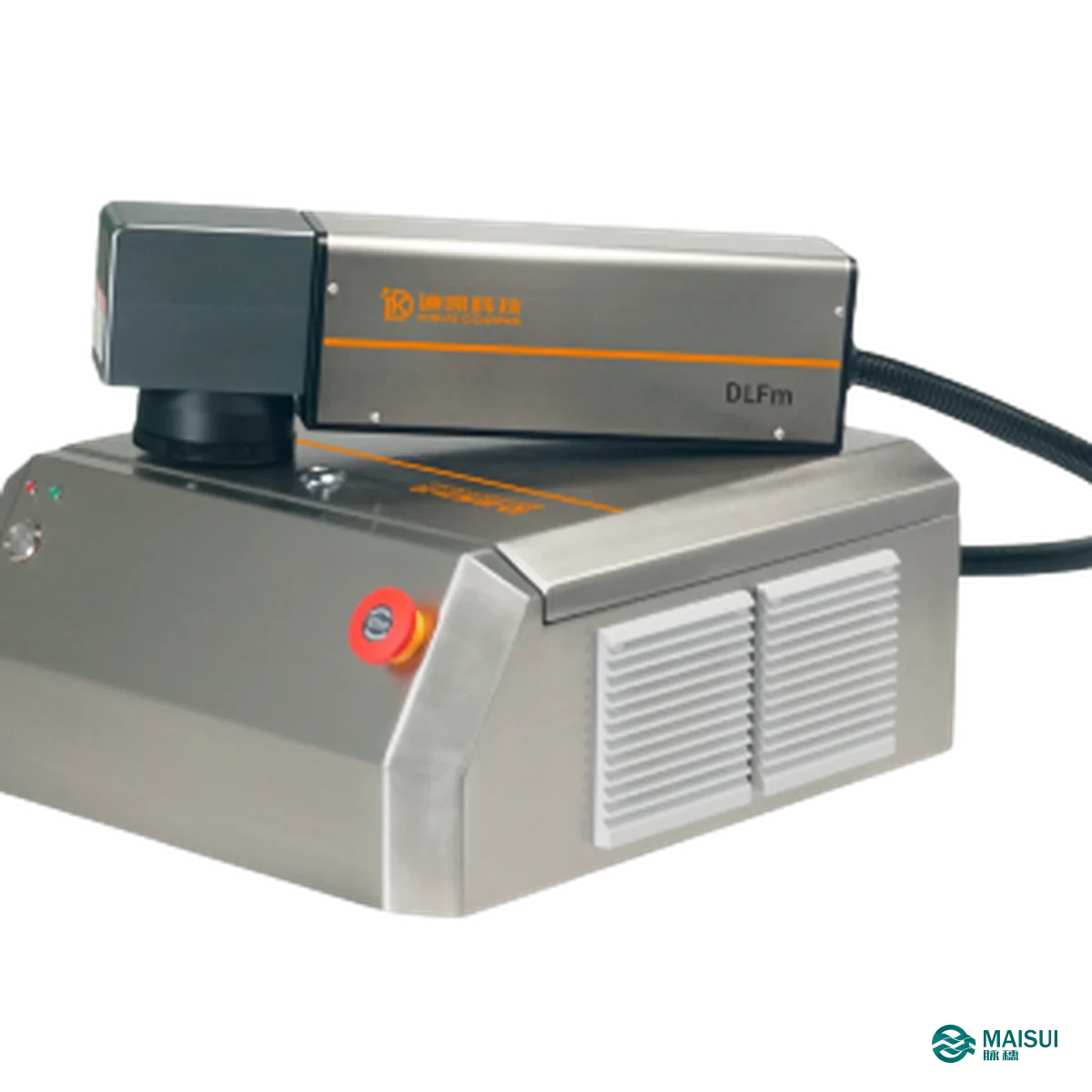
The Dikai DLFm is a compact fiber laser printer for film, PP and metal that runs fiber or MOPA sources from 30 W to 100 W at 1064 nm. It marks at up to 8,000 mm/s, offers five marking fields up to 400 x 400 mm, and its flying-mode speed can be configured to 0-150, 0-300 or 0-500 m/min – the high-speed variant being the reason most customers choose this model over the DLFe.
Key facts at a glance
- Category
- Fiber laser printer (coding and marking)
- Brand / series
- Dikai DLFm
- Laser source
- Fiber laser or MOPA laser, 1064 nm
- Output power
- 30 W / 60 W / 100 W
- Flying marking
- 0-150 / 0-300 / 0-500 m/min, depending on configuration
- Marking speed
- Up to 8,000 mm/s
- Marking fields
- 110, 150, 175, 300 and 400 mm square
- Cooling
- Air cooling, IP54
What it is
A fiber laser printer writes a permanent mark directly into the material with a 1064 nm beam. Because there is no ink, ribbon or label, nothing can smear, fade or run out during a shift. The DLFm is the compact, high-speed member of the Dikai fiber range: it keeps a small body for tight installation spaces while offering higher laser power and a wider speed range than the entry-level DLFe.
How it works
- Mount the laser body at the working distance for the chosen field – 110 mm up to 400 mm square.
- Set the message, date rules, barcode or 2D content on the controller.
- Choose static marking, or flying marking at the configured speed range.
- Trigger one mark per product from the machine; multiple products can also be marked in static mode.
- Check first packs for contrast and code grade, then run continuously.
Key capabilities
- Three power classes. 30 W, 60 W and 100 W, so the same platform covers a standard line and a high-speed line.
- Fiber or MOPA. MOPA adds pulse control that improves contrast on some plastics and gives colour-change marking on stainless steel.
- High-speed flying mode. Up to 500 m/min as a configuration option – the differentiator against the DLFe.
- Wide field range. Five lenses from 110 to 400 mm square, up to 587 mm working distance.
- Compact body. 418 x 93 x 110 mm laser body fits into tight installation spaces.
- IP54 air cooled. No chiller and no coolant loop.
- Rich content set. 26 fonts, barcodes, 2D codes and bitmap or vector graphics.
- Line integration. USB, Ethernet and RS232, with 2-way input and 3-way output.
Where it fits
It is the model for film and PP lines running at high throughput, and for metal or plastic parts that need a permanent serial or 2D code. Where the film is a thin mono structure and a light mark is essential, UV is usually the better family; where the line is fast and the material responds to 1064 nm, the DLFm’s 500 m/min option is the deciding feature.
Technical specifications
| Applicable materials | Soft packaging film, PP, metal and similar |
|---|---|
| Marking method | X and Y axis simultaneous scanning |
| Marking mode | Flying mark 0-150 / 0-300 / 0-500 m/min; static mark, multiple products at once |
| Laser type | Fiber laser, MOPA laser |
| Wavelength | 1064 nm |
| Output power | 30 W / 60 W / 100 W |
| Guiding laser | Red light guiding |
| Marking area / distance | 110 x 110 / 198 mm, 150 x 150 / 271 mm, 175 x 175 / 295 mm, 300 x 300 / 473 mm, 400 x 400 / 587 mm |
| Marking speed | Up to 8,000 mm/s |
| Fonts | 26 built-in fonts, user-defined fonts supported |
| Barcodes | Code 39, Code 25, EAN-13, Code 128 and others |
| 2D codes | PDF417, QR code, DataMatrix |
| Images | BMP, DXF, PLT, HPGL, JPEG |
| Variable data | Serial number, text, date, time, counter, shift code |
| Inputs / outputs | 2-way input / 3-way output, customisable |
| Interface | USB, Ethernet, RS232 |
| Installation direction | Any direction |
| Cooling | Air cooling, at least 10 cm clearance at the air inlet |
| Power supply | 100-240 V, 10 A, 47/63 Hz |
| Power consumption | 300 W / 400 W / 500 W by power class |
| Working temperature | -5 to 45 degrees C |
| Working humidity | 10 to 95 percent, no condensation |
| IP rating | IP54 |
| Dimensions | Laser body 418 x 93 x 110 mm; touch screen 305 x 207 x 56 mm; fume extractor 440 x 400 x 180 mm |
Selection checklist
- What line speed must be covered – does the 0-500 m/min option decide the model?
- Which material: film, rigid plastic or metal?
- Is MOPA needed for contrast or colour-change marking?
- Which marking field fits the code and the product size?
- Is fume extraction required for the material?
- Which signal triggers the mark on the line?
- Does the code need GS1 or customer-specific structure?
- Is the installation space tight enough to need the compact body?
Maintenance and service
Routine work is lens cleaning and keeping the air inlet clear; the laser source itself has no consumable. Where the material releases fume, the supplied extractor filter becomes the service item. MAISUI supplies, installs and services the unit and can match it to an existing mounting arrangement where a line is being upgraded.
Frequently asked questions
What makes the DLFm different from the DLFe?
Higher power classes (up to 100 W), the 400 mm marking field and the 0-500 m/min flying-mode option. The DLFe is the entry model up to 30 W with 0-150 m/min.
Do I need the 100 W version?
Only if the line speed or the mark density demands it. Most packaging lines are covered by 30 W or 60 W; the 100 W unit is for high-throughput or deep-marking applications.
What is the advantage of MOPA?
MOPA gives pulse control, which improves contrast on some plastics and enables colour-change marking on stainless steel. It is an option, not a requirement.
How fast can it run in flying mode?
0-150 m/min as standard, with 0-300 and 0-500 m/min as configuration options.
Is it air cooled?
Yes, IP54 air cooled with at least 10 cm clearance at the air inlet.
How large a field can it cover?
Up to 400 x 400 mm at 587 mm working distance, with smaller 110 to 300 mm options.
Does it need fume extraction?
Where the material releases fume when marked, yes – the brochure lists a 440 x 400 x 180 mm extractor for this series.
Can it print GS1 DataMatrix?
Yes, the controller supports DataMatrix including GS1 content, plus QR, PDF417 and common 1D barcodes.