
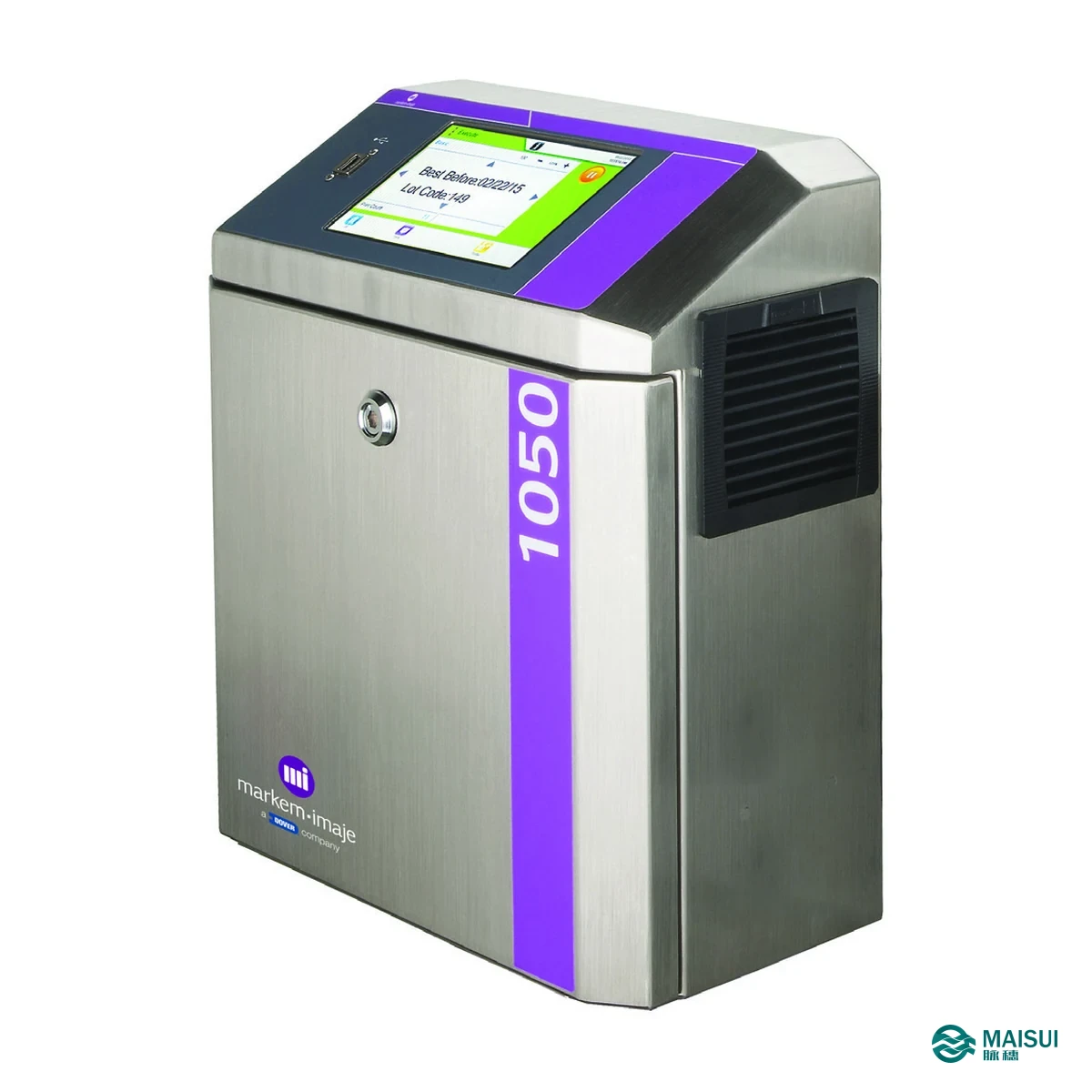
The Markem-Imaje 1050 is a mid-volume thermal inkjet (TIJ) coder for high-resolution date, batch and traceability codes on cartons, labels and flexible packs. It prints up to 600 x 600 dpi at a specified maximum line speed of 201 m/min, covers print heights from 12.7 mm to 50.8 mm with one to four printheads, and runs from snap-in ink cartridges or an optional 680 ml / 1360 ml bulk ink module. A 177.8 mm (7-inch) touch screen and optional CoLOS software complete the package.
Key facts at a glance
- Category
- Thermal inkjet (TIJ) coder
- Model
- Markem-Imaje 1050
- Print resolution
- Up to 600 x 600 dpi; print density variable from 1 to 600 dpi
- Line speed
- Up to 201 m/min (660 ft/min)
- Print height
- 12.7 mm to 50.8 mm, depending on printhead configuration
- Printheads
- Up to four 12.7 mm heads, two 25.4 mm heads or one 50.8 mm head
- Ink
- Snap-in cartridges; optional 680 / 1360 ml bulk module (aqueous inks only)
- Interface
- 177.8 mm (7-inch) touch screen; 1 x Ethernet, 2 x USB, 2 x RS-232
What it is
The 1050 is a cartridge-based thermal inkjet coder built for mid-volume coding: the printed image is formed by a thermal printhead that fires ink onto the package without touching it, so the code can be printed on a curved label, a filled carton or a film wrap while the line is running. Markem-Imaje positions the 1050 as a low-maintenance, easy-to-operate unit, with the ink supplied in a snap-in cartridge that the operator changes as a consumable.
Print height is set by the head configuration rather than by a single fixed head. One 12.7 mm cartridge prints a date code or a small lot code, while two 25.4 mm heads or a single 50.8 mm head cover larger panels; the controller drives up to four 12.7 mm heads, so several coding points can be supplied from one cabinet. Resolution is adjustable in the job up to 600 x 600 dpi, which is what makes small text, logos and high-density 2D codes printable at production speed.
The controller is built around a 177.8 mm (7-inch) touch screen with a WYSIWYG job editor and print preview, three levels of menu-driven security and a workflow manager that an administrator can use to standardise how jobs are created and released. Industrial solid-state electronics with no moving parts and a stainless steel enclosure keep the cabinet usable in dusty, humid and corrosive surroundings, and the design is portable enough to move between lines when the production plan changes.
How it works
- Mount each printhead on its bracket at the coding point and set the head-to-product distance. The 1050 takes one to four heads in the 12.7 mm, 25.4 mm or 50.8 mm size.
- Fit the snap-in cartridge into the printhead. For longer runs, connect the optional 680 ml or 1360 ml bulk ink delivery module and its supply line; the bulk option is for aqueous inks only.
- Create or import the message on the 7-inch touch screen: static text, user inserts, date and time stamps, shift codes, counters, bitmaps and variable data. Windows TrueType fonts can be loaded, and jobs can also be created and distributed from optional CoLOS software.
- Connect the photocell and encoder to the controller so that each product triggers a print at the right position, then set the print density and the job parameters.
- Start production and check the code. Print density and draft mode are job settings, so ink consumption can be tuned per product without changing hardware.
Key capabilities
- Up to 600 x 600 dpi. Print density is variable from 1 to 600 dpi in the job, so text, logos and high-density graphics can be optimised for the package instead of being fixed at one resolution.
- Up to 201 m/min. The specified maximum line speed covers high-speed packaging and labelling lines; the usable speed for a given job depends on resolution, print height and data density.
- 12.7 mm to 50.8 mm print height. One 50.8 mm head, two 25.4 mm heads or up to four 12.7 mm heads can be driven from the same controller.
- Barcodes at production rates. 1D formats include Code 128, Code 39, Code 93, EAN8, EAN13, EAN128, Interleaved 2 of 5, Pharmacode, Plessey, UPC-A and UPC-E; 2D formats include Data Matrix, QR Code, Micro QR Code, PDF417, Aztec and Maxi Code, with more formats on request.
- Cartridge or bulk ink. Snap-in cartridges for normal duty, or the optional 680 ml / 1360 ml bulk delivery module for aqueous inks on longer runs, with draft mode and variable print density to control ink use.
- Low-maintenance printhead. The ink is contained in the cartridge, so the operator replaces a consumable rather than servicing an ink circuit.
- 177.8 mm touch screen. WYSIWYG template editing, print preview, three security levels and a workflow manager for standardised job creation.
- Plant connectivity. One Ethernet port, two USB ports and two RS-232 ports, plus encoder and sensor inputs, with optional CoLOS Enterprise for central code management.
Where it fits
The 1050 is aimed at secondary packaging and case coding where the code has to be readable rather than simply present: retail-ready cartons, food and beverage multipacks, label stock and logistics cases. The print height range covers a small date code on one line and a multi-line lot, address or barcode block on another, and the barcode library supports traceability, promotion and retail compliance work. Because up to four printheads can run from one controller, a second coding point can be added to the same cabinet as the line grows.
It is also a practical choice where the environment is not clean-room: Markem-Imaje specifies the coder for dusty, humid and corrosive areas, and the stainless steel enclosure with solid-state electronics is designed for that duty. Site conditions still need to be checked against the operating limits before selection.
Technical specifications
| Print technology | Thermal inkjet (TIJ), cartridge-based printhead |
|---|---|
| Maximum resolution | 600 x 600 dpi |
| Print density | Variable from 1 to 600 dpi, set in the job |
| Maximum line speed | 201 m/min (660 ft/min) |
| Print height | 12.7 mm to 50.8 mm, depending on printhead configuration |
| Printhead options | Up to four 12.7 mm (1/2 inch) heads, two 25.4 mm (1 inch) heads or one 50.8 mm (2 inch) head |
| Print features | Static text, user inserts, date and time stamps, shift codes, counters, bitmaps, conditional bitmaps, variable data |
| Fonts | Windows TrueType fonts |
| Barcodes 1D | Codabar, Code 128, Code 39, Code 93, EAN8, EAN13, EAN128, Interleaved 2 of 5, Pharmacode, Plessey, UPC-A, UPC-E |
| Barcodes 2D | Aztec, Data Matrix, Maxi Code, Micro QR Code, PDF417, QR Code, QR Code 2005; additional formats on request |
| Operator interface | 177.8 mm (7-inch) touch screen; WYSIWYG template and print preview |
| Access control | Three levels of menu-driven security; workflow manager for the print process |
| Electronics | Industrial solid-state electronics with no moving parts |
| Connectivity | 1 x Ethernet, 2 x USB, 2 x RS-232; encoder and sensor ports |
| Sensor pin out | P3-Hi (PnP), P6-GND, P7-Low (NPN), P8-12VDC |
| Enclosure | Industrial stainless steel |
| Power supply | 110-240 VAC, 50/60 Hz, 1.3 A |
| Bulk ink option | 680 ml or 1360 ml bulk ink delivery module, aqueous inks only |
| Operating temperature | Printer -10 to 40 C; aqueous inks 10-40 C (except 10068196-S at 5-40 C); solvent inks 15-35 C |
| Humidity | 0-80 % RH, non-condensing |
| Software | CoLOS Enterprise (optional) |
| Printhead mounting | Several printhead and mounting options; configuration selected with a Markem-Imaje applications engineer |
Inks and bulk ink
The 1050 runs on snap-in cartridges, and the optional bulk ink delivery module is available in 680 ml or 1360 ml and is specified for aqueous inks only. Draft mode and variable print density can be used to reduce ink consumption on high-volume work, and the job settings decide how much ink a given code uses.
Markem-Imaje lists the ink working range by type: aqueous inks 10-40 C (except ink 10068196-S at 5-40 C) and solvent inks 15-35 C, and notes that inks may work outside these ranges depending on the application and environment. Ink choice follows the substrate and the process – coated and uncoated board, labels, films and non-porous surfaces can each need a different grade – so MAISUI checks the ink against a sample and the line conditions before the quotation, and confirms local availability of the grade.
Selection checklist
- What print height does the largest code need: one line of 12.7 mm, or a block up to 50.8 mm across?
- How many coding points will one controller drive, now and in the next two years?
- What is the real line speed at the coding point, and what resolution is acceptable for the code?
- Which substrates run on the line: coated board, labels, film, or a mix?
- Is the daily volume enough to justify the bulk ink module, or are cartridges sufficient?
- Which inks are compatible with the process: aqueous or solvent, and is the local supply confirmed?
- Is the coding area dusty, humid or corrosive? Check the enclosure and the environment against the limits.
- Does the line need CoLOS or another central job-management system, or is stand-alone operation enough?
Maintenance and service
Routine maintenance is built around consumables. The printhead cartridge is a snap-in part and the controller has no moving parts, so the daily work is a print check, a cartridge change when the ink runs out and keeping the printhead area clean. Jobs, users and access levels are managed on the touch screen or centrally through CoLOS.
MAISUI supplies matched cartridges and the bulk ink module where it is specified, and can arrange operator training, start-up support and a preventive maintenance schedule sized to the production hours. Keeping one spare cartridge per printhead on the shelf avoids a stop when a cartridge runs out mid-shift, and ink orders should follow the logged consumption rather than a calendar estimate.
Frequently asked questions
What is the Markem-Imaje 1050?
The 1050 is a mid-volume thermal inkjet coder. It prints dates, batch and lot codes, text, logos and barcodes on cartons, labels and flexible packs without touching the product, and it is built around snap-in cartridges and a 7-inch touch screen.
What print height can the 1050 cover?
From 12.7 mm to 50.8 mm. One 50.8 mm head covers the full height, two 25.4 mm heads can be stacked, or up to four 12.7 mm heads can be combined on the same controller.
How fast can it print?
The specified maximum line speed is 201 m/min (660 ft/min). The usable speed for a given job depends on the resolution, the print height, the data density and the head-to-product distance, so confirm the layout on your product.
What is the maximum resolution?
600 x 600 dpi, with print density variable from 1 to 600 dpi in the job. That is what allows small text and high-density 2D codes to print at production speed.
Does it print barcodes?
Yes. 1D formats include Code 128, Code 39, Code 93, EAN8, EAN13, EAN128, Interleaved 2 of 5, Pharmacode, Plessey, UPC-A and UPC-E; 2D formats include Data Matrix, QR Code, Micro QR Code, PDF417, Aztec and Maxi Code. Other formats are available on request.
Can it use bulk ink?
Yes, as an option. The 680 ml or 1360 ml bulk ink delivery module is specified for aqueous inks only. With solvent inks the coder runs on snap-in cartridges.
What interfaces does the controller have?
One Ethernet port, two USB ports and two RS-232 ports, plus encoder and sensor inputs (sensor pin out P3-Hi PnP, P6-GND, P7-Low NPN, P8-12VDC). Optional CoLOS Enterprise software connects the coder to a central job-management system.
What are the operating conditions?
The printer is rated for -10 to 40 C and 0-80 % relative humidity non-condensing. Ink working ranges are 10-40 C for aqueous inks (5-40 C for ink 10068196-S) and 15-35 C for solvent inks, and Markem-Imaje notes that inks may work outside these ranges depending on the application and environment.
What is the difference between the 1050 and the 1200?
Print height and ink volume. The 1050 covers 12.7-50.8 mm with smaller heads and aqueous bulk ink of 680 or 1360 ml; the 1200 is a large-character printer for 50.8-203 mm case coding, with bulk ink modules up to 2720 ml for Markem-Imaje standard inks.
How do I get a quotation or the datasheet?
Send the code layout, line speed, substrate and print height to MAISUI. We reply with a configured quotation and lead time within 24 hours on business days, and the official datasheet is available on request through the Request datasheet link.