
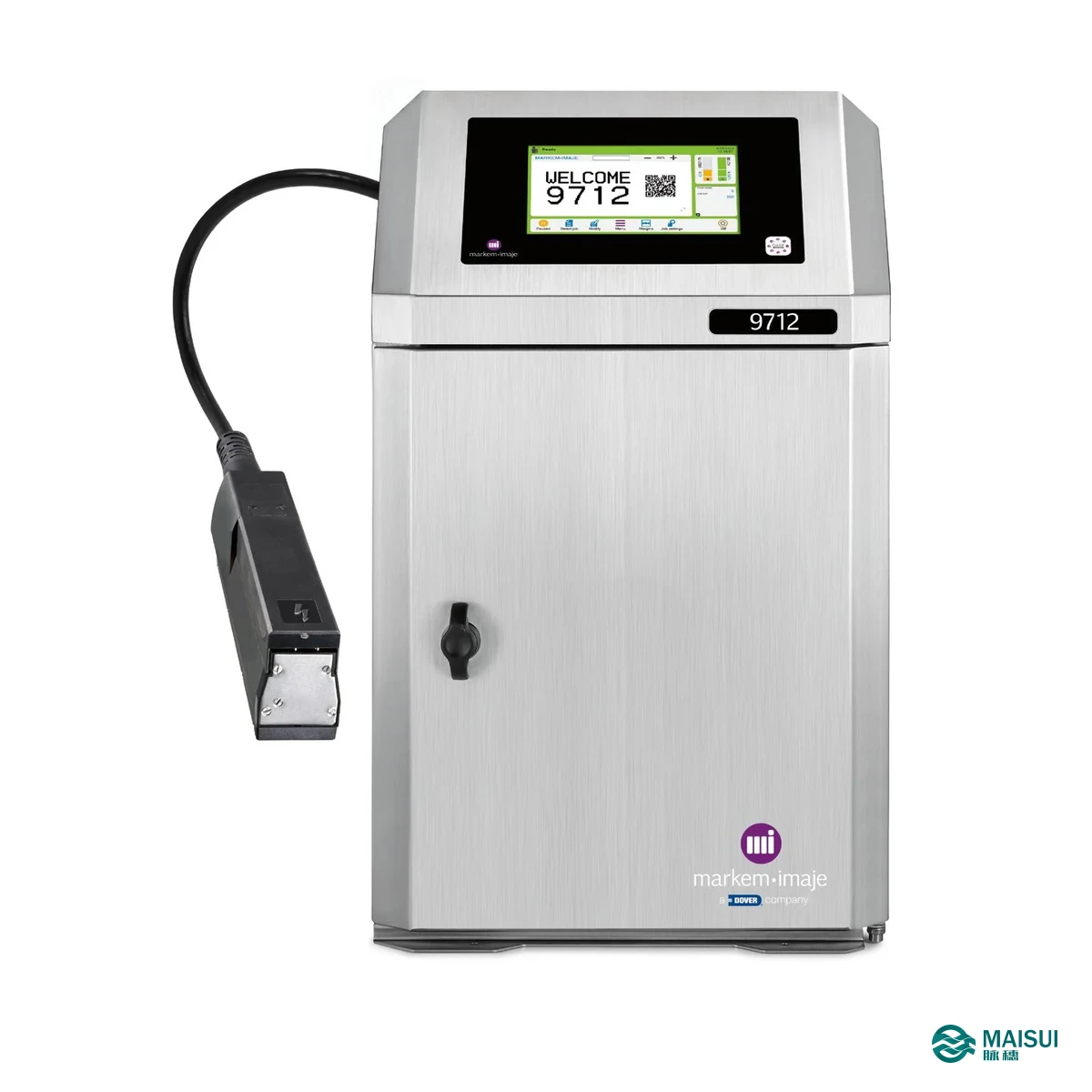
The Markem-Imaje 9712 is a bi-jet continuous inkjet coder that prints up to 8 lines or twice the data of a single-jet coder. Two printhead nozzles work together at 71 or 115 dpi, at up to 4.46 m/s, with characters from 1.2 to 8.2 mm per jet. The 7-inch capacitive touch screen, front-access modular ink circuit and IP56 cabinet are built for lines that need more code without more floor space.
Key facts at a glance
- Category
- Continuous inkjet (CIJ) bi-jet coder
- Model
- Markem-Imaje 9712
- Printhead
- Bi-jet: G head at 71 dpi or M head at 115 dpi
- Lines and speed
- Up to 8 lines; up to 4.46 m/s
- Character height
- 1.2-8.2 mm per jet; font height 5-24 dots per jet
- Interface
- 7-inch capacitive colour touch screen; USB, Ethernet, serial and M12 I/O
- Ink circuit
- Sealed 0.8 L cartridges; 100% front-access modular circuit
- Protection
- IP56 stainless steel; no plant air required
What it is
The 9712 is the bi-jet member of the Markem-Imaje CIJ family. Instead of one jet it uses two, so it can print twice the information in the same footprint – up to 8 lines, or a wider message, or the same code twice – without slowing the line. That makes it suitable for premium packs and regulated products where a lot of data has to be legible at speed.
The coder is built from swappable modules. The ink circuit is accessible from the front of the cabinet, the printhead carries embedded intelligence for marking quality and reduced maintenance, and remote services include a virtual assistant for self-troubleshooting. Markem-Imaje states that the design reduces consumable consumption and VOC emissions by up to 50 % while improving operator safety and total cost of ownership.
How it works
- Install the cabinet beside the conveyor and position the bi-jet printhead at the coding point with the 3 m umbilical.
- Fit the sealed 0.8 L cartridges and let the coder prime and stabilise the jets; the automatic system handles start-up.
- Create the message on the 7-inch capacitive touch screen: multi-line layouts, logos, 1D and 2D codes including Dotcode, dates and batch data.
- Connect the photocell, encoder and I/O through the M12 or 24-pin connector, and set the trigger and line speed.
- Run the line. Jet Speed Control keeps drop placement and code consistency, and remote diagnostics feed predictive maintenance.
Key capabilities
- Bi-jet printhead. Up to 8 lines, or twice the data in the same print window, at up to 4.46 m/s.
- 71 dpi or 115 dpi. G head for speed, M head for high-resolution text and 2D codes.
- 1.2 to 8.2 mm characters per jet. Font height from 5 to 24 dots per jet, with mixed-height layouts.
- 7-inch capacitive touch screen. Real-time print capacity in hours and messages, integrated assistance, user profiles, consumption and availability tracking.
- Front-access modular ink circuit. 100 % front access for preventive maintenance, with controlled additive consumption.
- Remote services. Virtual assistant for 24/7 self-troubleshooting, live helpdesk with video and connected printer services.
- Industry 4.0 connectivity. USB, Ethernet, serial and a configurable M12 connector, plus an optional 24-pin I/O interface.
- IP56 stainless steel cabinet. Table-top or vertical mounting, no plant air required.
Where it fits
The 9712 is aimed at producers who run out of print area before they run out of data: multi-language ingredient panels, long batch and traceability strings, 2D codes on small components, or two codes side by side on one product. It suits beverage, dairy, food, pharmaceutical and cosmetics lines where the same coder has to handle several pack formats without losing speed.
Technical specifications
| Print technology | Continuous inkjet, bi-jet printhead |
|---|---|
| Print resolution | G head 71 dpi; M head 115 dpi |
| Print lines | Up to 8 lines |
| Print speed | Up to 4.46 m/s |
| Font height | 5 to 24 dots per jet |
| Character height | 1.2 to 8.2 mm per jet |
| Barcodes | EAN8, EAN13, UPCA, UPCE, code 39, interleaved 2 of 5, Datamatrix, QR code, Dotcode |
| Character sets | Latin, Arabic, Cyrillic, Hebrew, Japanese, Chinese, Korean |
| Message library | Up to 1000 messages |
| Operator interface | 7-inch capacitive colour touch screen; user profiles; consumption and availability tracking |
| Ink system | Sealed 0.8 L cartridges with foolproofing system; compact modular circuit |
| Ink types | Multi-use and high-performance inks; alcohol-based, ketone-free and MEK-free |
| Connectivity | USB, Ethernet, serial and configurable M12 connector; 24-pin I/O option |
| Remote services | Virtual assistant, live helpdesk with video, connected printer services |
| Umbilical | 3 m ultra-flexible cable; 2 m or 6 m options |
| Cabinet | Stainless steel cabinet and printhead case |
| Protection rating | IP56 |
| Plant air | Not required; printhead pressurisation kit and ultimate protection option |
| Operating temperature | 0 to 50 °C, depending on ink used |
| Humidity | 10 to 90 % non-condensing |
| Power supply | 100-240 V; 1.6 A; 50/60 Hz |
| Weight | 25 kg |
Inks and cartridges
The 9712 uses sealed 0.8 L cartridges and a broad ink range: multi-use and high-performance inks, alcohol-based, ketone-free and MEK-free grades. The compact ink circuit is designed for better thermal management and controlled additive consumption, and the printhead carries embedded intelligence so that maintenance is reduced over the life of the machine.
Because the bi-jet head can print two jets with different inks or resolutions, ink selection is decided per application rather than per machine. MAISUI confirms the combination – G head or M head, ink grade, code size – against your product sample before the quotation.
Selection checklist
- How much data must the code carry, and does it fit on one jet or does it need two?
- Do you need 71 dpi speed or 115 dpi resolution for small text and 2D codes?
- What line speed, and what character height per jet?
- Which substrates and process conditions apply?
- Will the coder connect to a line controller through M12, 24-pin I/O or Ethernet?
- Do you need remote diagnostics and connected printer services on site?
- What umbilical length does the installation need – 2 m, 3 m or 6 m?
- Do you need the optional ultimate water and dust protection for wash-down areas?
Maintenance and service
The 9712 is designed for front-access maintenance: the modular ink circuit is reached from the front of the cabinet and the printhead carries embedded intelligence that reduces maintenance work. Remote services include a virtual assistant for self-troubleshooting and a live helpdesk with video support, so simple faults can be resolved without waiting for a site visit.
MAISUI supplies the coder with matched inks, cartridges and printhead parts, and sets up the connected services where they are available in the region. Consumable consumption and availability are logged on the coder, which makes the preventive maintenance schedule predictable.
Frequently asked questions
What is the 9712?
The 9712 is a bi-jet continuous inkjet coder. Two jets let it print up to 8 lines, or twice the data of a single-jet coder, in the same print window at up to 4.46 m/s.
What is a bi-jet printhead?
Two printhead jets working together. That doubles the printable lines or the code width without increasing the line speed, which is useful when a product carries a lot of data.
What resolution is available?
The G head runs at 71 dpi and the M head at 115 dpi. The M head is the choice for small text and dense 2D codes; the G head favours speed.
Which codes can it print?
Text, dates, batch fields, logos, 1D and 2D codes including Datamatrix, QR code and Dotcode. Character sets include Latin, Arabic, Cyrillic, Hebrew, Japanese, Chinese and Korean.
Does it need compressed air?
No. The 9712 is IP56 and runs without plant air. An ultimate water and dust protection option and a printhead pressurisation kit both require plant air.
How is the ink circuit maintained?
The circuit is modular and 100 % accessible from the front of the cabinet, which simplifies preventive maintenance. Ink is supplied in sealed 0.8 L cartridges.
Can it be monitored remotely?
Yes. Remote services include a virtual assistant for self-troubleshooting, a live helpdesk with video support and connected printer services where available in the region.
What is the operating environment?
0 to 50 °C depending on the ink used, and 10 to 90 % relative humidity non-condensing. Power supply is 100-240 V at 1.6 A.
Can I get a quotation for the 9712?
Send the code content, pack format, line speed and resolution requirement. MAISUI replies with a matched quotation, head choice and ink recommendation within 24 hours on business days.