
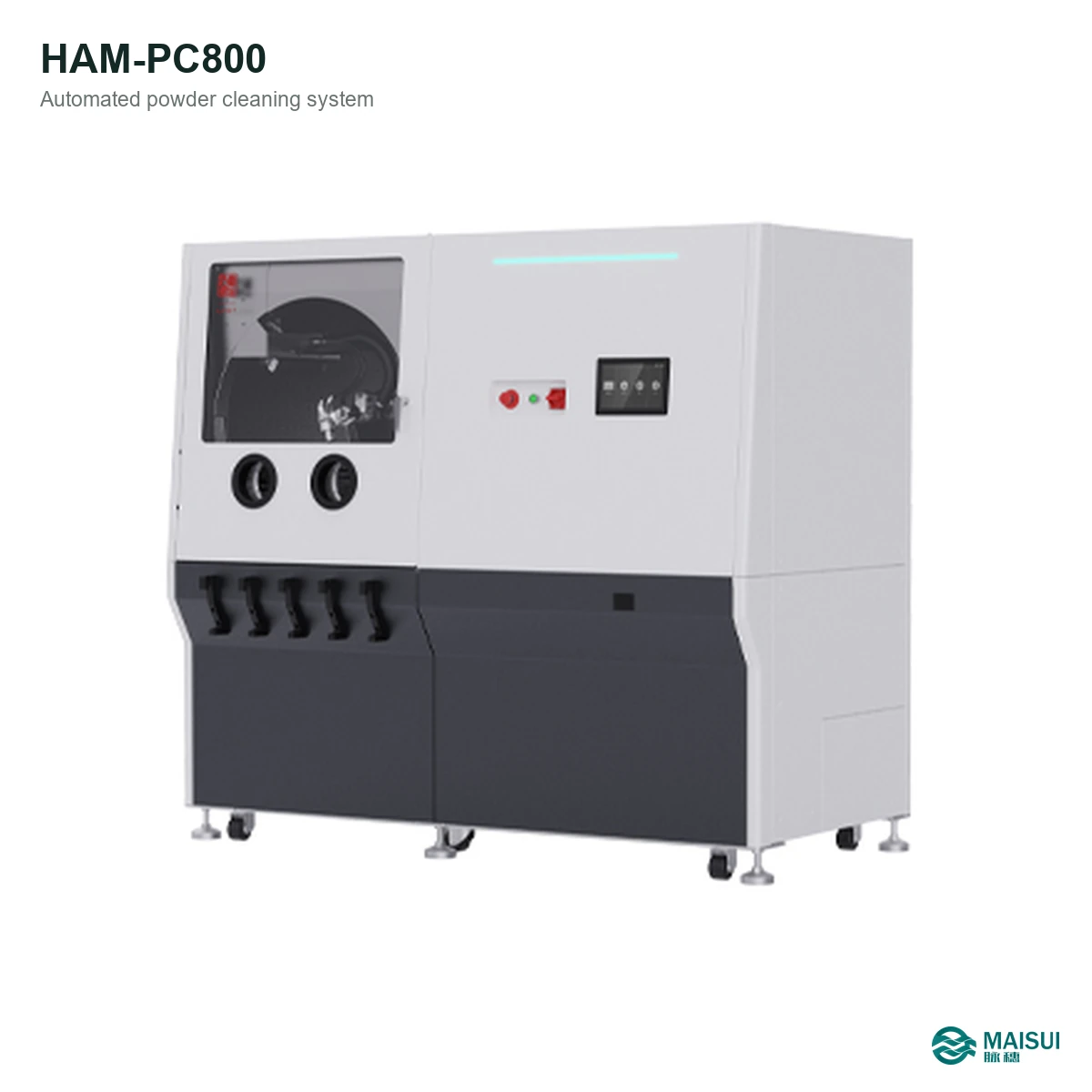
The HPRT HAM-PC800 is a automated powder cleaning and recovery system with 57 L effective processing volume, automatic sandblasting and 10-20 min per batch, built for powder removal from freshly printed parts.
Key facts at a glance
- Category
- 3D printers and additive manufacturing
- Brand / model
- HPRT HAM-PC800
- Technology
- Automatic sandblasting
- Machine size
- 2000 x 1210 x 2000 mm
- Batch capacity
- 1.5 SJF-P380 builds
- Effective volume
- 57 L
- Cycle time
- 10-20 min
- Weight
- 800 kg
What it is
The HPRT HAM-PC800 is a automated powder cleaning and recovery system. It works with Quartz glass or PS blasting media and produces parts within 57 L effective processing volume. The machine is designed for powder removal from freshly printed parts and fits into a workshop where parts are designed digitally and produced on demand.
Compared with subtractive machining, additive manufacturing builds the part layer by layer, so internal channels, lattices and short-run geometries that would need extra tooling can be produced directly from a file.
How it works
- Export the part as STL or the native job file and slice it for the machine.
- Prepare the machine: load material, check the build plate or powder bed and confirm the job.
- Run the build; the machine reports progress and any faults.
- Remove the finished part and clean off support, powder or resin.
- Carry out post-processing: Cleaned parts can move to dyeing or assembly with less manual handling.
- Inspect the part against the drawing and log the build parameters.
Materials and consumables
Quartz glass or PS blasting media. Consumable quality and storage affect the result: keep filament dry, keep resin out of UV light and handle powder in a controlled area. HPRT specifies the material range for the machine; test the actual material before production.
Software and workflow
Parts are prepared in a slicer or the printer software and sent to the machine via memory card or network, depending on the model. For production use, keep a job library with versioned files and record which machine and material produced each part, so the same result can be repeated.
Key capabilities
- Technology. Automatic sandblasting.
- Machine size. 2000 x 1210 x 2000 mm.
- Batch capacity. 1.5 SJF-P380 builds.
- Effective volume. 57 L.
- Cycle time. 10-20 min.
- Weight. 800 kg.
- Air requirement. 7 bar; 2.5 m³/min.
- Media. Quartz glass, PS.
Where it fits
- powder removal from freshly printed parts
- powder recovery for reuse
- cleaning before dyeing or assembly
Typical environment: a design office, workshop or production cell where parts are made in small batches and design changes are frequent.
HPRT 3D printing range at a glance
| Model | Type | Build / process size | Typical use |
|---|---|---|---|
| SJF-P380 | Industrial powder-bed (SJF) | 380 x 280 x 380 mm | Functional parts and small-batch production |
| HAM-PC800 | Powder cleaning | 57 L per batch | Post-processing after printing |
| HAM-PD400 | Deep dyeing | Φ400 x 390 mm | Colouring 3D printed parts |
| F210 | Desktop FDM | 220 x 220 x 250 mm | Prototypes, jigs, teaching |
| FDM-F110 | Entry desktop FDM | 100 x 100 x 85 mm | Education and small models |
| LCD-L228 | LCD resin | 228 x 121 x 300 mm | High-detail prototypes and models |
| LCD-L298 | 8K LCD elastomer | 294 x 160 x 400 mm | Elastomer parts, footwear, robotics |
Technical specifications
| Technology | Automatic sandblasting |
|---|---|
| Machine size | 2000 x 1210 x 2000 mm |
| Batch capacity | 1.5 SJF-P380 builds |
| Effective volume | 57 L |
| Cycle time | 10-20 min |
| Weight | 800 kg |
| Air requirement | 7 bar; 2.5 m³/min |
| Media | Quartz glass, PS |
Site requirements and installation
Plan power, compressed air (if required by the model), ventilation and floor space before delivery. Powder and resin processes need controlled handling and waste. Confirm the exact services with MAISUI during project scoping.
Selection checklist
- What part size, material and accuracy are required?
- Is the part for prototyping, tooling or end-use production?
- What monthly volume and build frequency should the machine handle?
- Which post-processing steps are needed, and who performs them?
- What power, air and ventilation are available on site?
- Who will operate, maintain and service the machine?
Maintenance and service
Follow the manufacturer service schedule for the hot end, optics, powder handling or resin vat, and keep spare consumables on site. MAISUI provides installation support, training and after-sales service.
Frequently asked questions
What is the HAM-PC800?
An automated powder cleaning unit for 3D printed parts.
How much can it process?
57 L per cycle, about 1.5 SJF-P380 builds.
What media does it use?
Quartz glass or PS blasting media.
How long is a cycle?
10 to 20 minutes.
What air supply is needed?
7 bar and 2.5 m³/min.
Does it recover powder?
The unit is designed for powder cleaning and recovery in a production line.
Is it manual or automatic?
Automatic sandblasting reduces manual handling.
What maintenance is needed?
Media and filter maintenance per the manufacturer schedule.
Can it handle other printers?
It is sized around SJF-P380 builds; check part size for other printers.
Can I get a quotation?
Send part size and volume through the contact form.